The number of female
gamers is on the rise. It is a common
misconception that there are significantly more men playing video games than
there are women. According to a recent
study by the Entertainment Software Association, forty seven percent of gamers
in the year 2012 were women, meaning the remaining fifty three percent were
men. Despite the increased female
demographic, the gaming industry continues to crank out more male main
characters than it does female. The
female characters that have been presented to us as main characters have proven
to be interesting to say the least. By
looking at some of the gaming industry’s most iconic action girls we can see
what men have come to expect of their female characters as well as what out
society might be able to do to improve on them.
It is nearly impossible to play a video game and not come
across a trope. This term refers to describe
a common element seen in any type of entertainment. When a female character has the ability to
participate in combat and succeed in her endeavors, she is referred to as an
action girl. This trope in video games
has been around for decades. When Metroid was released for the NES in
1986, players who skillfully completed the game were shocked to find that Samus
Aran was a woman. This was a surprise to
many gamers who were becoming comfortable with male action heroes. To this day, many see Samus as a character
who helped pave the way for other action girls.
Indeed, other female characters have followed in Samus’ footsteps to
become console and PC hits. Tifa from
the massive hit Final Fantasy VII as
well as numerous characters from several Bioware titles are just a few examples
of popular action girls.
Other than Samus, no action girl is more recognizable or
has been embraced by the gaming community more than Lara Croft of the Tomb Raider series. In every new title of the series, Lara gets
down and dirty to take out the bad guys and get whatever treasure she is
after. She uses not only her guns, but
also her cunning and intelligence to solve the puzzles presented to her. The 1996 release of the first Tomb Raider was followed by much
critical acclaim and gamers across the globe fell in love with Lara. Overall, the idea behind Lara as a character
is a good one. Every feminist loves a
rough and tumble female character who has brains to boot. Unfortunately, Lara has a few assets that
have drawn attention away from her physical and mental strength. A
subtrope that is common among action girls is that the size of a woman’s chest
determines her strength. If a female
character is presented as a bombshell, then it follows that she is likely to
win a few fights. This supports the idea
that the only way a woman can be strong is if she conforms what the patriarchal
society has deemed to be perfect. It is
not just the size of Lara’s chest that falls into an overly sexualized
subtrope. This clip
follows
the evolution of Croft’s appearance. Note
the lack of change from outfit to outfit as the series progresses. Where no hiker in his or her right mind would
opt to walk in anything shorter than his or her knee, Lara the adventurer is
depicted wearing shorts that don’t even reach her mid-thigh. There is nothing wrong with this length or
lack thereof until one assesses the practicality of the clothing in question. Quite simply, it is highly impractical. The tank top covering her infamous breasts
always allows gamers a view of her midriff and is unforgivably tight in areas
male gamers would deem important.
 |
| The traditional Lara (left) opposed to the reboot (right) |
A reboot of the popular series was released earlier this
year and has received mixed reviews. A
quick search on any review site that focuses more on gameplay will yield high
ratings. GameSpot, which takes into
account all platforms, gave the game a score of 8.5. Obviously, those worried about bugs, story line
and playability thought highly of the reboot.
Internet trolls sent forums ablaze, however, when promotional images
were released depicting a new Lara.
Standing in a dark cave, Lara is covered in mud and blood. She dons her signature tank top, but this
time it covers normally proportioned breasts.
Voice actress Jennifer Hale revealed that it was originally planned that
Lara would be wearing nothing but a bra beneath a vest. Eventually, the idea was tossed aside and the
designers settled from a plain tank top.
Gone are her signature hot pants.
This time around, Lara has chosen to do her adventuring in practical
long pants and boots. Before the game
was even released, many male responses to the promotional shots stated
something along the lines of missing the “old Lara.” As none of these men had played the game yet,
it can only be assumed that they were referring to the drastic toning down her
Lara’s sexuality. Entertainment Weekly’s Keith Staskiewicz believes that the change
in Lara’s appearance may be in response to the changes in the gaming
community. As more women move in to pick
up the controllers, more gamers are becoming aware of the problems that occur
when women are portrayed in games.
Some
might claim that this is “just a game” and it has no real affect on women in
our society. This is not that case,
though. As stated above, it is a fact
that more girls are picking up gaming as a hobby and not all of those girls
know that the high standards set by Lara are outrageous. There are girls out there who might look up
to the Laras and Samuses of the gaming world.
These games are teaching girls that the only way to be truly strong is
to be sexual as well. There is nothing
wrong with embracing your body type and being proud of how you look, but when a
girl measures her own personal worth by those standards, it is a problem. Young men are being affected by this problem
as well. When boys reach the conclusion
that ogling at a woman’s breasts or thighs is acceptable when it is on a console, that tends to transfer over to real life. When a girl who thinks the only part of her
worth loving is her body meets a boy who believes that women are only around
for his viewing pleasure, problems arise and the girl is not likely to leave
the situation happy.
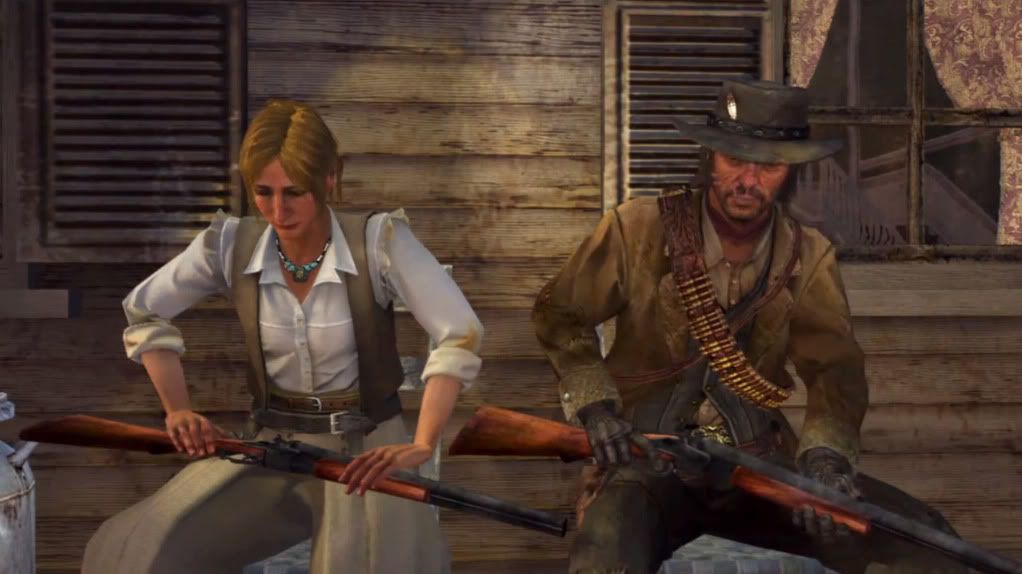 |
| Bonnie sits with protagonist John Marston while donning practical rancher wear |
While Tomb Raider
took seventeen years to get it right, some games have achieved an amazing
action girl on their first try. A
personal favorite is Red Dead Redemption’s
Bonnie MacFarlane. She is a rancher and
business woman who has chosen to reject the idea that she ought to get married
and let a man take the reins. When the
main protagonist John Marston meets her, it is very clear that she is in charge
and every man on the ranch is to answer to her.
Where Tomb Raider made a show
out of Lara Croft’s appearance, Redemption
does the opposite with Bonnie. Her
clothing is practical and true to the historical context of the game. She is not the bombshell action girl male
gamers have come to expect from watching characters like Lara Croft. It is not just her appearance that makes
Bonnie a phenomenal example of what an action girl ought to be. As stated before, Bonnie is a business
woman. She serves as a manager on her
ranch and uses her intellect to get everything done. In her article on American masculinity as it
is portrayed in Red Dead Redemption,
Sara Humphreys notes that Bonnie’s relationship with Marston is based in
economics when the developers could have made him a love interest of
her’s. Bonnie does not use her
femininity to sway Marston to do work on the ranch; she simply points out that
Marston owes her money and his life and treats him like any other
employee. Humphreys makes it clear that
Bonnie is not a woman who is trying to be a man. She is simply a masculine woman. While most action girls do not mind getting
down and dirty, Bonnie is one of the true masculine of center women that can be
found in video games.
Even Bonnie is not without her flaws, however. Humphreys looks at the effects of a domestic
setting on Bonnie and notes that her personality is not as dynamic. She tones down her usually commanding
attitude in order to appease her father who is himself a very outspoken
individual. In addition to her behavior
in the home, there is a very brief point in the plot during which she becomes
the damsel in distress. A group of
outlaws kidnaps her, beats her, and attempts to hang her in order to get their friend
set free. This cut scene shows
the kind of attitude the outlaws took toward Bonnie during her kidnapping. The clip is long, but the first few minutes should
be enough to get the feel for the kind of people Bonnie was dealing with. John, being the masculine hero that he is,
goes to save her from her captors. I
would argue, however, that these flaws are not as bad as they might seem. When playing this game, one has to remember
that there is some historical context to keep in mind. A woman was still expected to remain in the
domestic sphere during the time of Western Expansion. The fact that Bonnie was in charge of an
entire ranch was an amazing accomplishment.
Even the matter of the kidnapping is a little more understandable when
one looks at what Bonnie was up against.
If one woman is pitted against a group of men, it does not take a genius
to see that the odds were not in her favor.
The fact that the kidnapping of individuals occurred given the time
period makes the damsel in distress situation a bit more excusable within the
game.
The fact that is not excusable is that these situations
and events occurred in our nation’s history.
Bonnie is not the only woman in this game, but she is certainly the
luckiest. As an unmarried woman, she was
not forced into prostitution or marriage.
She got to be a business woman.
Throughout the game, though, we see the murder of prostitutes as well as
weak, unmarried women struggling to get by.
Bonnie was not the norm, but the other women were. As a gamer, one might think that some of the
abusive and misogynistic imagery in the game is disgusting. Not many gamers, however, are taking on an idea
of change. The fact remains that some women
are shunned if they are not married while others feel as though they need to take
up a life of prostitution to survive. This
reflection on our nation’s history should spur some sort of change in our modern
society, but somehow it does not.
The gaming community can only claim that it is male dominated
by a small margin. As more girls pick up
controllers, more changes are going to have to be made. Gaming among feminists is hardly uncommon and
the demand for all around kick ass female characters is on the rise. If female characters can be created whose strength
has no correlation to the size of their boobs, a community of female gamers can
be built who feel the same way about their own bodies. There can be so much more to female characters
than their curves, and it is about time developers start tuning in on that.
Works
Cited
Entertainment Software Association.
"Who Is Playing." Essential
Facts about the Computer and Video Game Industry (2012): 2-3. Print.
Humphreys, Sara. "Rejuvenating 'Eternal Inequality on the Digital Frontiers of Red
Dead Redemption." Western American
Literature 47.2 (2012): 200-15. Print.
Rockstar Games. Red Dead Redemption. Take-Two Interactive, 2010. XBox 360.
Staskiewicz, Keith. "Lara Croft's
Next Adventure." Entertainment
Weekly 8 Mar. 2013: n. pag. Print.
"Tomb Raider." GameSpot. GameSpot, n.d. Web. 1 May
2013. <http://www.gamespot.com/tomb-raider/>.